How UC Riverside Baseball Builds Its Roster: Three Years of Recruiting Data
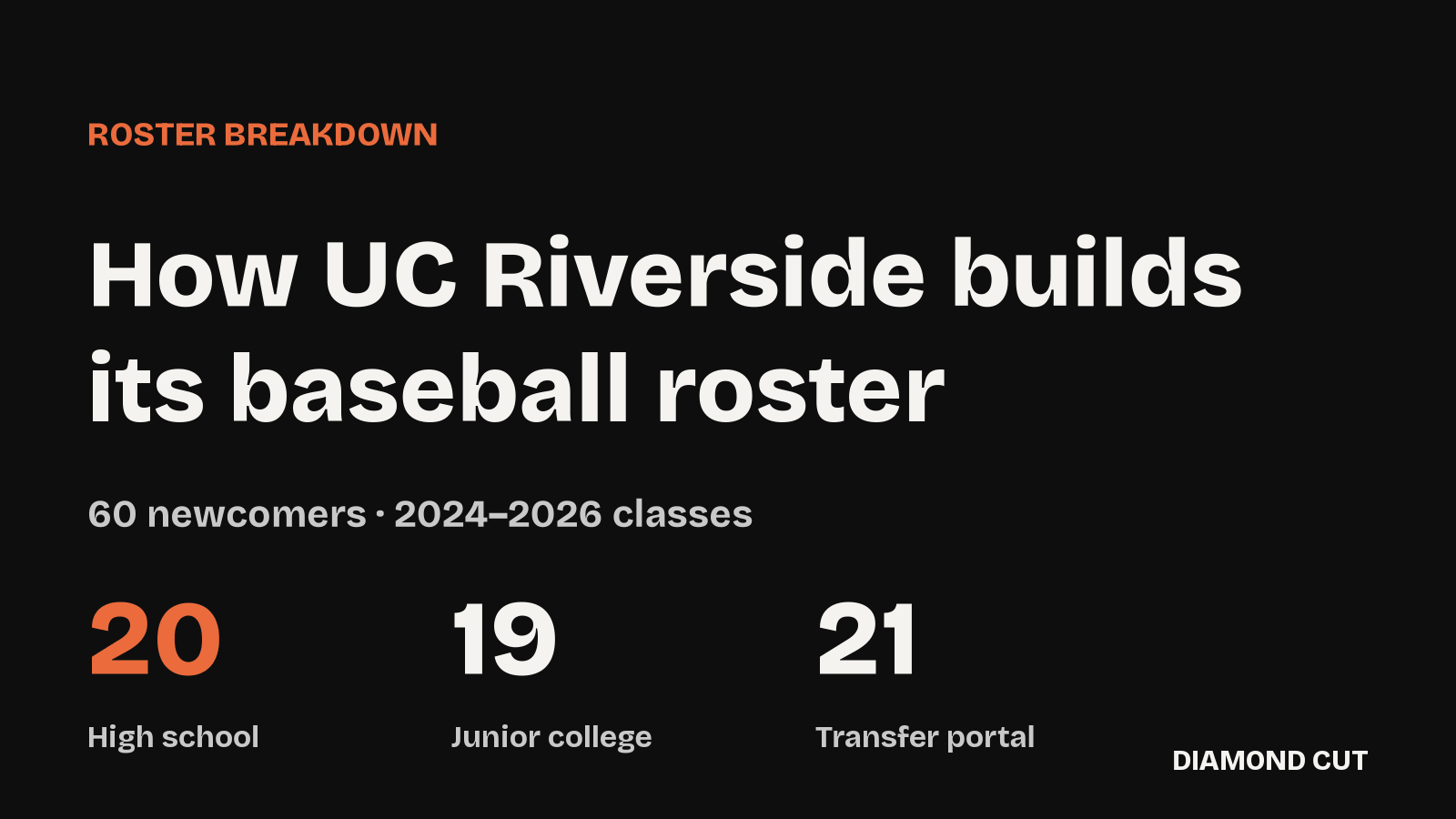
We broke down all 60 newcomers on UC Riverside's last three baseball rosters: where they're from, how big they are, and which positions come from high school, JUCO and the transfer portal.
University of California, Riverside plays NCAA Division I baseball in the Big West Conference. From 2024 through 2026, between 39% and 76% of each UC Riverside roster was new.
We went through UC Riverside's official rosters and pulled every newcomer from the last three classes, 60 players in all. Then we sorted them by how they got there: straight from high school, from a junior college, or from another four-year school through the transfer portal.
The short version
- 20 newcomers came from high school, 19 from junior colleges and 21 from four-year schools.
- 58 of the 60 newcomers grew up in California, including 20 of the 20 high school signees.
- 9 of the 21 four-year transfers came from Division I programs.
- The average newcomer is 6-0.5 and 194 pounds.
Where UC Riverside's recruits come from
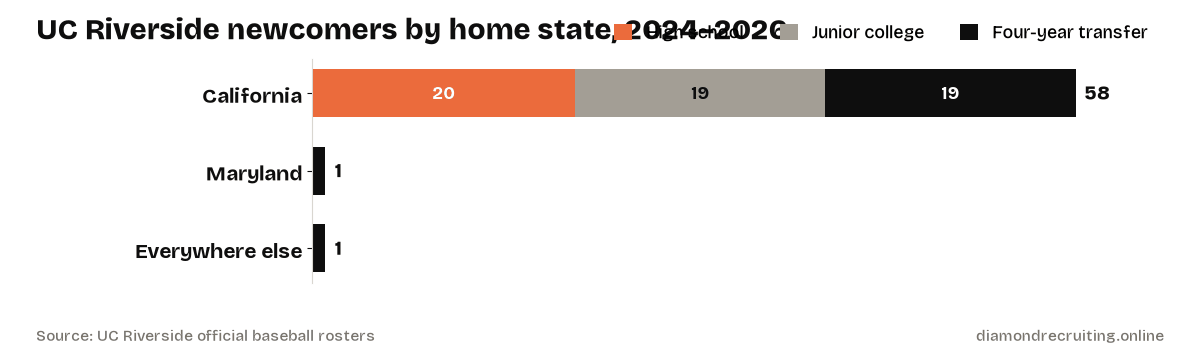
20 of UC Riverside's 20 high school signees grew up in California.
UC Riverside added 19 junior college players in three classes, with the most from Skyline College (2).
The 21 four-year transfers came from 18 different schools. The schools that sent more than one: Los Medanos College (2), CSUN (2) and San Diego State (2).
How big are UC Riverside's newcomers?
The average newcomer stands 6-0.5 and weighs 194 pounds. Here's how each position group measured:
- Right-handed pitchers (21): 6-1.4 on average, from 5-8 to 6-6
- Left-handed pitchers (8): 5-11.9 on average, from 5-9 to 6-3
- Catchers (7): 5-11.6 on average, from 5-11 to 6-1
- Infielders (13): 6-0.6 on average, from 5-10 to 6-5
- Outfielders (10): 5-11 on average, from 5-9 to 6-4
- Utility players (1): 6-6
High school signees are the heaviest group at 199 pounds, against 189 for junior college players and 195 for four-year transfer players.
Which positions come from high school, JUCO and the portal
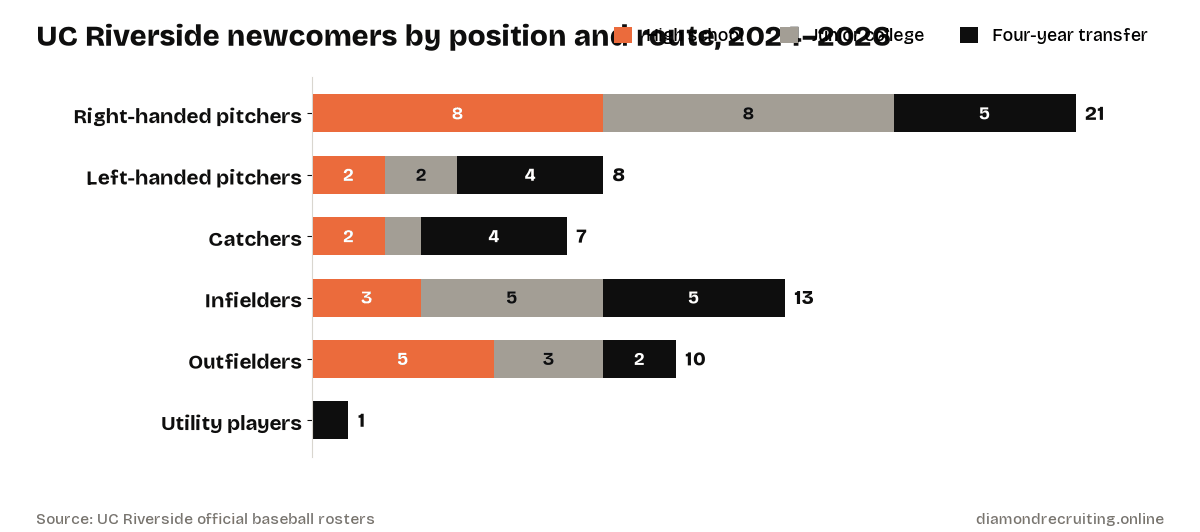
- Right-handed pitchers: 8 came straight from high school and 8 came from junior colleges, out of 21.
- Left-handed pitchers: 4 of 8 came through the transfer portal.
- Catchers: 4 of 7 came through the transfer portal.
- Infielders: 5 came from junior colleges and 5 came through the transfer portal, out of 13.
- Outfielders: 5 of 10 came straight from high school.
How the last three classes compare
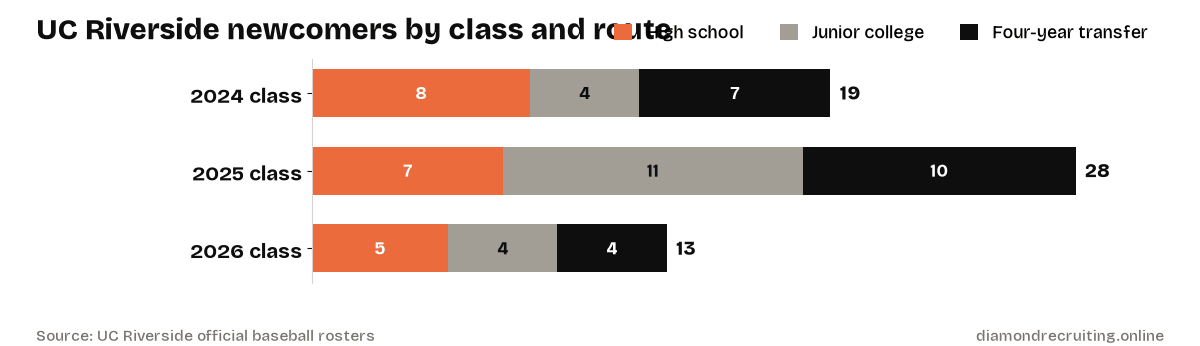
UC Riverside added 19 newcomers in the 2024 class, 28 in 2025 and 13 in 2026. High school signees went 8, 7, 5 across those classes; junior college players went 4, 11, 4; and four-year transfers went 7, 10, 4.
How UC Riverside's starters hit in 2026
We looked at UC Riverside's starter at every spot in the lineup and compared him to the average Big West hitter. We used OPS, which is on-base percentage plus slugging. The Big West average was .753.
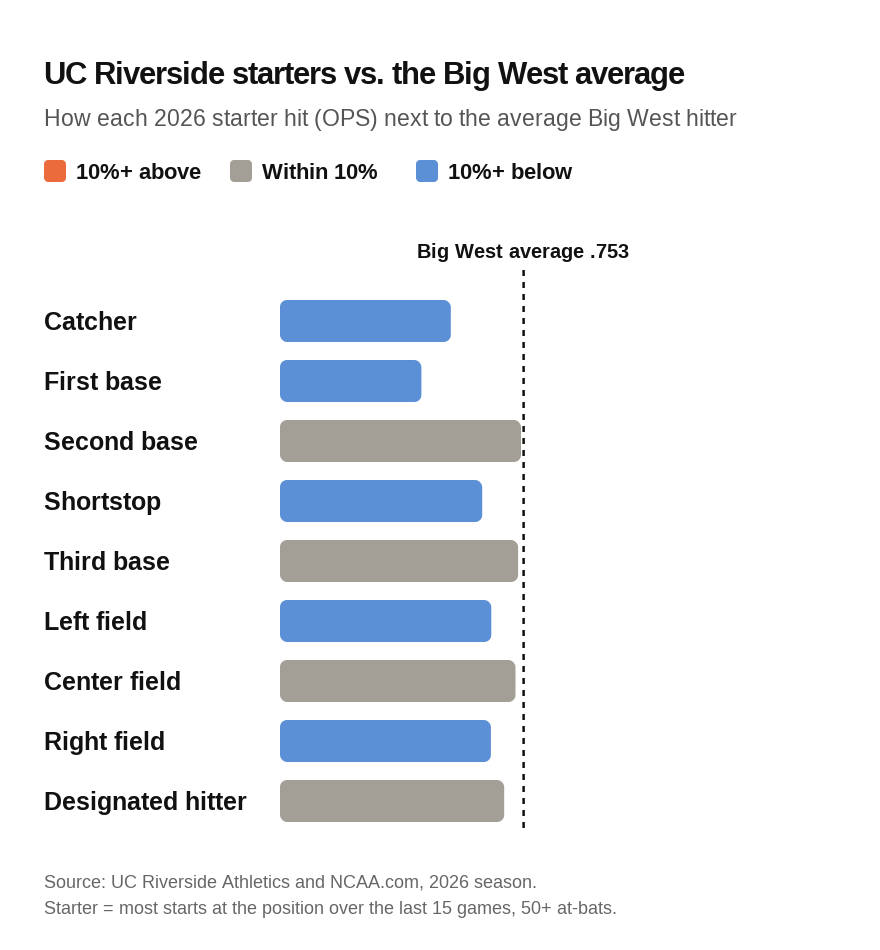
- Within 10% of the average: second base (.745), third base (.736), center field (.728) and designated hitter (.693).
- 10% or more below the average: catcher (.528), first base (.437), shortstop (.625), left field (.653) and right field (.652). These are the spots where a new player could earn at-bats.
The starter is the player with the most starts at each position over UC Riverside's last 15 games, with at least 50 at-bats. Stats come from UC Riverside Athletics and NCAA.com for the 2026 season.
What this means if you want to play at UC Riverside
- Biggest route: the transfer portal route brought in 21 of 60 newcomers, the most of any route.
- California high school players: 20 of 20 high school signees grew up in California, so in-state players make up most of the high school classes.
- JUCO players: UC Riverside took 19 junior college newcomers in three classes.
- Players at another four-year school: the portal supplied more than half of UC Riverside's newcomers at catcher.
Whatever your route, coaches need to see your film, stats and grades in one place. Build your free recruiting page and send it to the coaches on your list.
How we got these numbers
We counted a player as a newcomer if he was on UC Riverside's roster for a season but not the season before, using UC Riverside's official roster pages for 2023, 2024, 2025 and 2026. A player's route is the last college listed for him by UC Riverside, or his high school when no college is listed. Home states come from each player's listed hometown.
Diamond Cut is not affiliated with University of California, Riverside or the NCAA. This article uses public information from UC Riverside's official athletics website.