
Every Question a Coach Asks Before Recruiting You — Answered on One Page
Coaches don't read resumes — they scan them for answers to six silent questions. Here's what those questions are, how to answer each one, and how to put it all on a single page a coach can scan in 30 seconds.
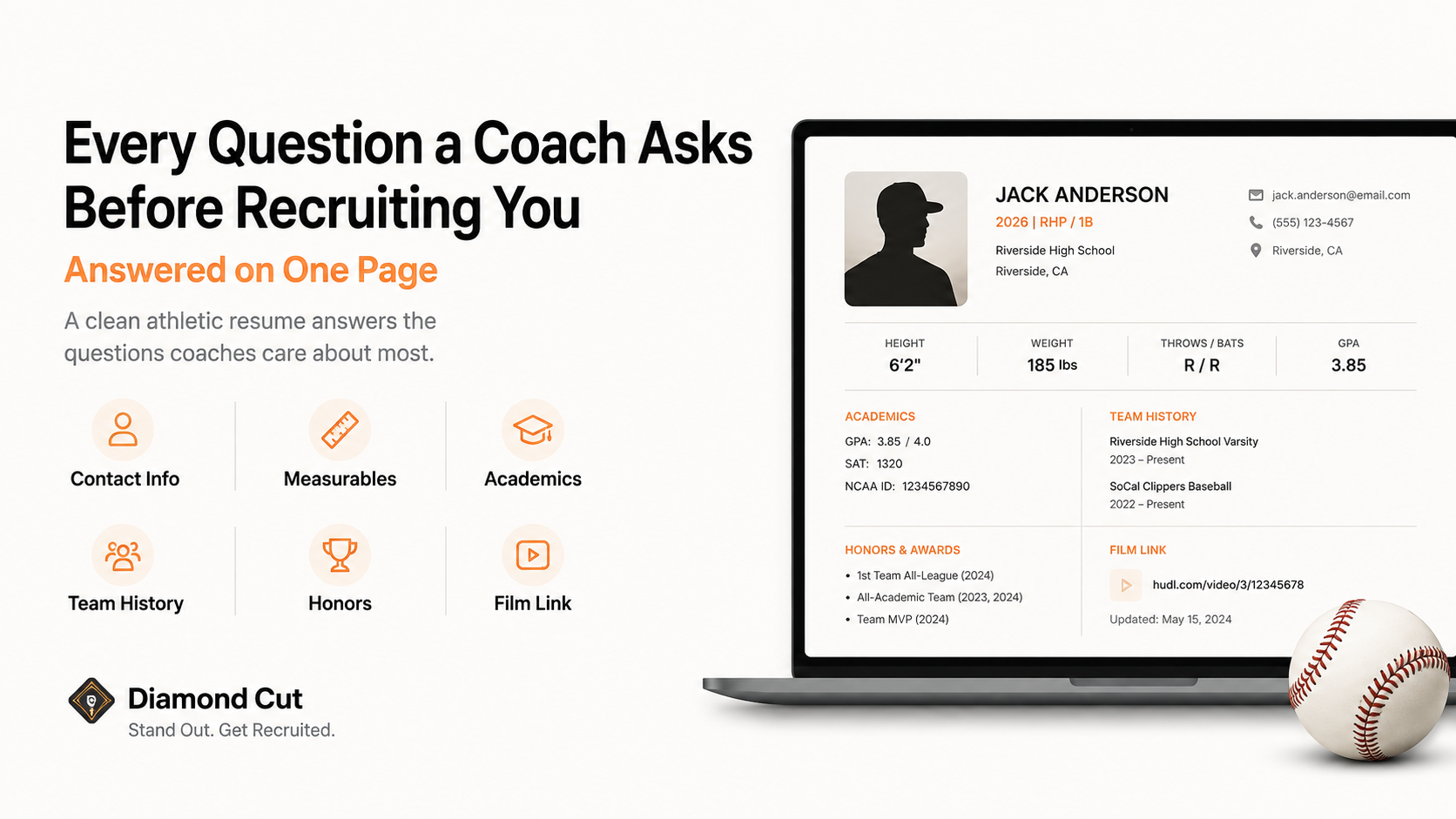
Every Question a Coach Asks Before Recruiting You — Answered on One Page
Ask ten student athletes what's in their recruiting toolkit and you'll hear the same three things: a highlight video, a list of target schools, and maybe a recruiting profile. Almost none of them mention the document that coaches actually reach for first — an athletic resume.
It's not flashy. It won't get likes on social media. But when a coach is deciding whether to spend the next three minutes watching your film or moving on to the next name in their inbox, they're really asking a short list of silent questions. A resume — or a recruiting profile built the right way — is what answers all of them before the coach has to ask.
The Questions a Coach Is Actually Asking
Every coach scanning a recruit is running through the same mental checklist, whether they say it out loud or not:
- Who is this athlete, and can I reach them?
- What do they measure out at?
- Can they handle the classroom here?
- Where have they played, and who can vouch for them?
- Have they actually competed, or just participated?
- Is there film I can watch right now?
A resume that answers all six, clearly and fast, is what separates a name a coach remembers from one they scroll past. Done right, it's not a highlight reel in text form — it's a fast, factual snapshot a coach can scan in under 30 seconds and answer every one of those questions themselves.
Six Questions, Six Answers
"Who is this athlete, and can I reach them?" Name, grad year, high school, position, height/weight, and contact info for you and your parents. Basic, but it's the first thing a coach checks — don't bury it.
"What do they measure out at?" Times, stats, rankings, exit velocity, vertical — whatever measurables carry weight in your sport. Be exact and be honest; coaches cross-check these against film and other sources more often than athletes expect.
"Can they handle the classroom here?" GPA, test scores, honors, relevant coursework. Academics are part of the evaluation from day one, not an afterthought if the athletics work out.
"Where have they played, and who can vouch for them?" High school and club teams, in reverse order, with your coaches' names attached. A coach reaching out to verify your game almost always starts here.
"Have they actually competed, or just participated?" Captain, all-conference, MVP, state qualifier — anything that shows you compete and lead, not just show up.
"Is there film I can watch right now?" Phone, email, and a direct link to your recruiting profile and highlight video. If a coach has to hunt for how to reach you or where to watch you play, most won't bother.
Formatting Rules That Actually Get Read
- One page. No exceptions. Coaches are scanning, not reading — density kills a resume faster than a weak stat line.
- Bullets over paragraphs. Every sentence a coach has to parse slows them down.
- Lead with your best line. Whatever stat or achievement is most impressive goes at the top of its section, not buried at the bottom.
- Skip the decoration. No stock graphics, no busy templates. A clean layout reads as professional; a crowded one reads as amateur.
- Send it as a PDF. Anything else risks the formatting breaking on a coach's phone or laptop.
The Mistakes That Quietly Kill a Resume
Most resumes don't fail because the athlete isn't good enough — they fail because of small, fixable things:
- Stats from last season that never got updated
- An email address that isn't first-name-last-name
- No coach contact info for a coach who wants to verify you
- Vague measurables instead of exact numbers
- A wall of text where bullet points should be
None of these take long to fix. All of them cost you a look if they're not.
One Link, All Six Questions Answered
Here's the problem most families run into: those six answers usually end up scattered. A resume in an email attachment, film on Hudl, stats in a group text, contact info buried three messages back. A coach shouldn't have to stitch that together themselves — and most won't try.
A Diamond Recruiting Online profile is built so that a coach gets every one of those six answers the second they click the link — stats first, then game highlights, then film, all in the order a coach actually wants to see it. Who you are, what you measure out at, your grades, your team history, your accolades, and your film — one page, one link, nothing to dig for.
It's the same information a strong athletic resume delivers, just built to travel: drop it in an email, a bio, a text, or a follow-up, and every question a coach is silently asking gets answered before they ever have to ask it.
Building a strong recruiting profile is one of the simplest, highest-leverage moves in the entire recruiting process. It doesn't win you a scholarship on its own — but it's very often the reason a coach decides to keep looking.
Want one link that answers every question a coach has before they even ask? Get started with Diamond Cut.