How Lipscomb Baseball Builds Its Roster: Three Years of Recruiting Data
We broke down all 51 newcomers on Lipscomb's last three baseball rosters: where they're from, how big they are, and which positions come from high school, JUCO and the transfer portal.
Lipscomb University plays NCAA Division I baseball in the ASUN Conference. From 2025 through 2027, between 40% and 51% of each Lipscomb roster was new.
We went through Lipscomb's official rosters and pulled every newcomer from the last three classes, 51 players in all. Then we sorted them by how they got there: straight from high school, from a junior college, or from another four-year school through the transfer portal.
The short version
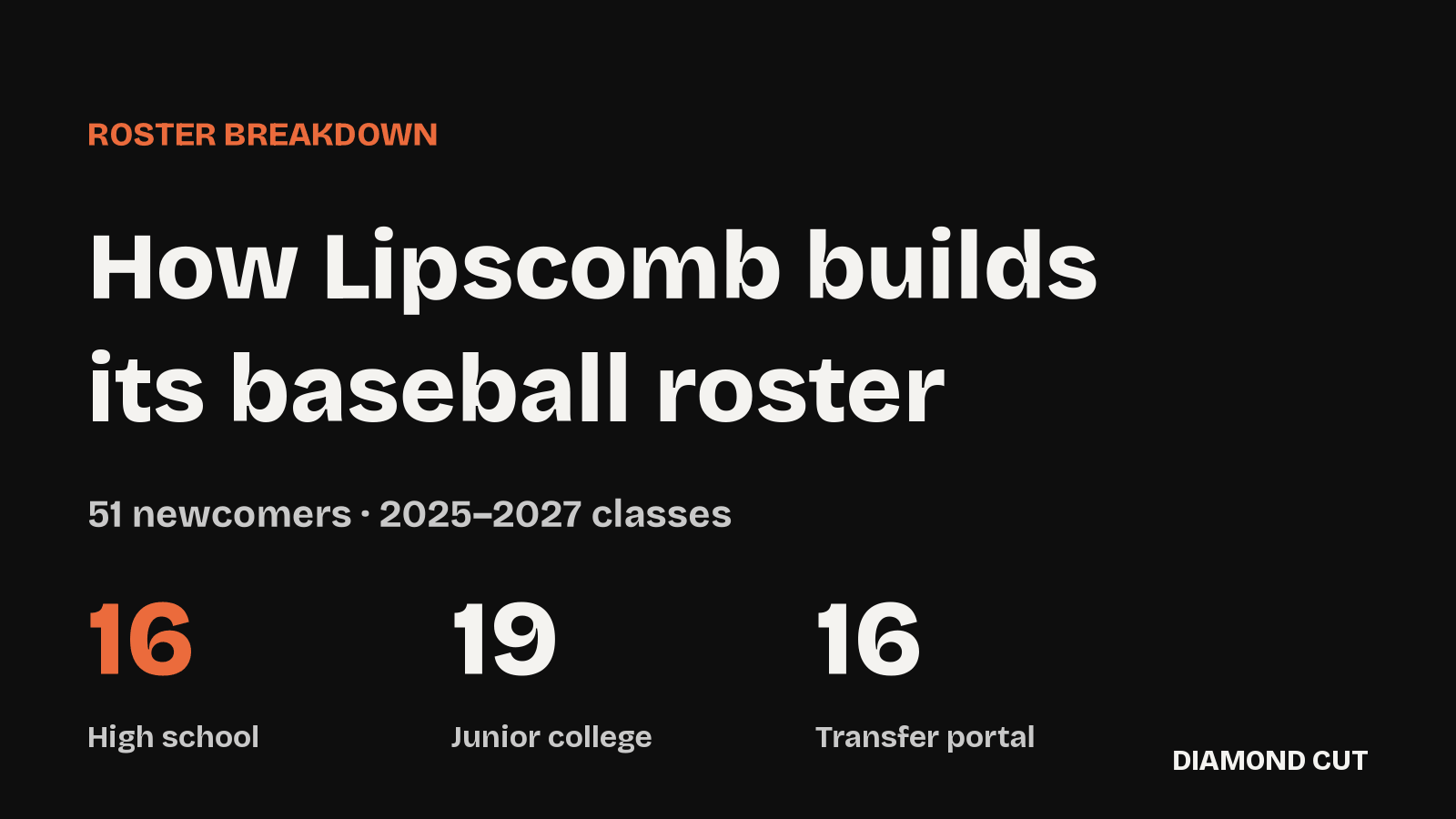
- 16 newcomers came from high school, 19 from junior colleges and 16 from four-year schools.
- 18 of the 51 newcomers grew up in Tennessee, including 11 of the 16 high school signees.
- Outside Tennessee, the biggest source was the Southeast with 18 newcomers, led by Florida with 11.
- 4 of the 16 four-year transfers came from Division I programs.
- The average newcomer is 6-1.1 and 198 pounds.
Where Lipscomb's recruits come from
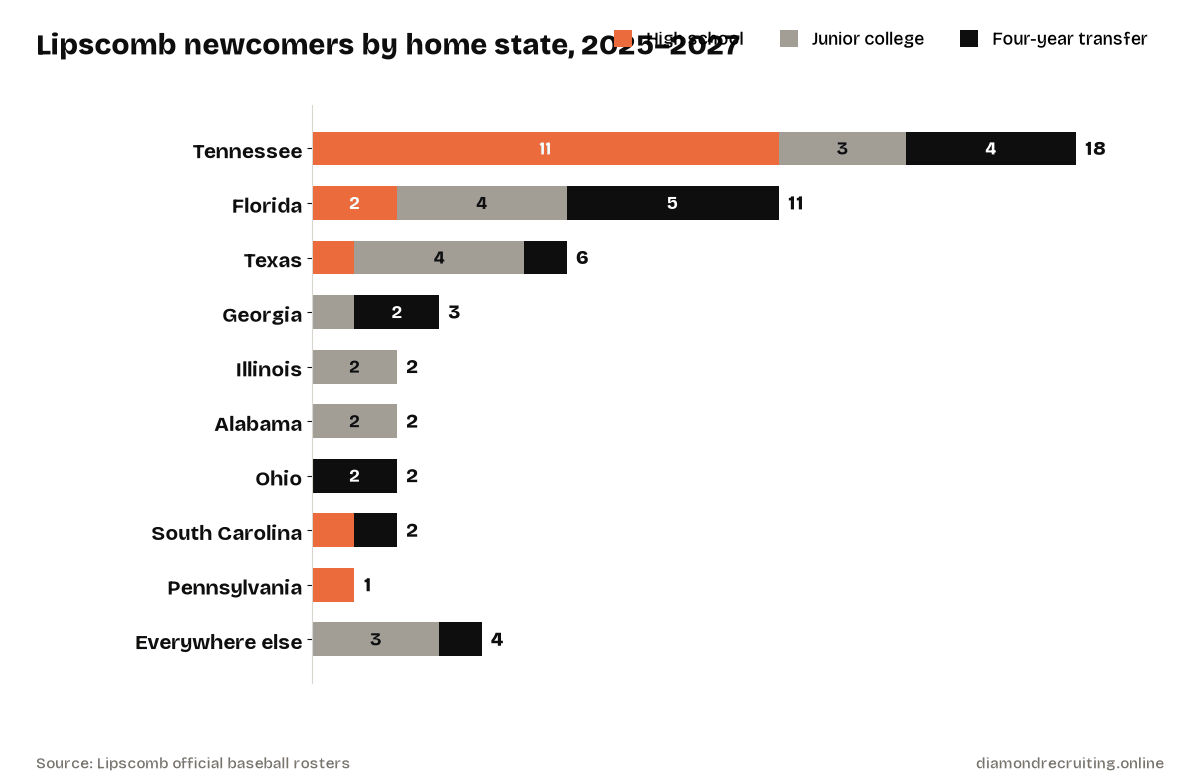
11 of Lipscomb's 16 high school signees grew up in Tennessee. The other 5 came from 4 other states and countries, led by Florida (2).
Lipscomb added 19 junior college players in three classes, with the most from Polk State College (3), Columbia State CC (3) and Seminole State College (2).
The 16 four-year transfers came from 15 different schools. The schools that sent more than one: Middle Tenn. State University (2).
How big are Lipscomb's newcomers?
The average newcomer stands 6-1.1 and weighs 198 pounds. Here's how each position group measured:
- Right-handed pitchers (11): 6-2.1 on average, from 5-10 to 6-7
- Left-handed pitchers (9): 6-2.6 on average, from 6-0 to 6-7
- Pitchers (hand not listed) (3): 6-0.7 on average, from 5-9 to 6-4
- Catchers (6): 6-0.8 on average, from 5-11 to 6-2
- Infielders (10): 6-1 on average, from 5-10 to 6-3
- Outfielders (7): 5-11.6 on average, from 5-10 to 6-2
- Utility players (5): 5-11.4 on average, from 5-9 to 6-1
Junior college players are the heaviest group at 201 pounds, against 193 for high school signees and 200 for four-year transfer players.
Which positions come from high school, JUCO and the portal
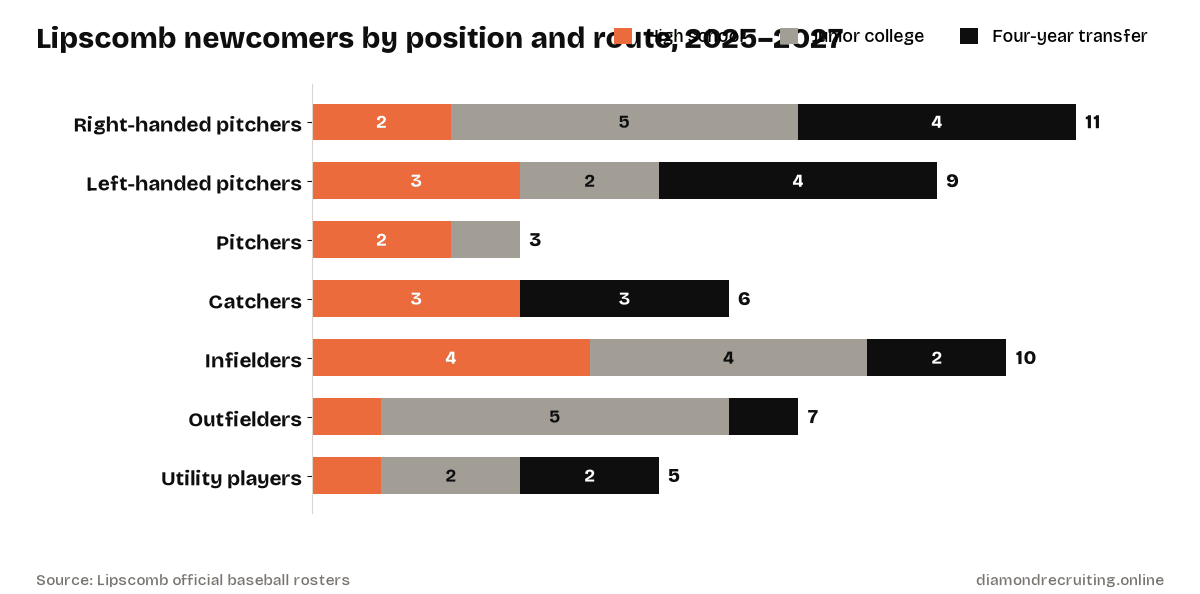
- Right-handed pitchers: 5 of 11 came from junior colleges.
- Left-handed pitchers: 4 of 9 came through the transfer portal.
- Catchers: 3 came straight from high school and 3 came through the transfer portal, out of 6.
- Infielders: 4 came straight from high school and 4 came from junior colleges, out of 10.
- Outfielders: 5 of 7 came from junior colleges.
- Utility players: 2 came through the transfer portal and 2 came from junior colleges, out of 5.
How the last three classes compare
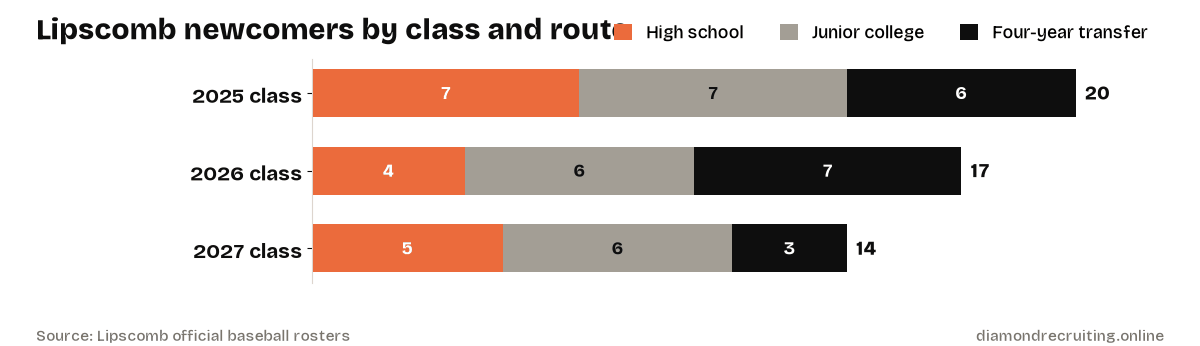
Lipscomb added 20 newcomers in the 2025 class, 17 in 2026 and 14 in 2027. High school signees went 7, 4, 5 across those classes; junior college players went 7, 6, 6; and four-year transfers went 6, 7, 3.
How Lipscomb's starters hit in 2026
We looked at Lipscomb's starter at every spot in the lineup and compared him to the average ASUN hitter. We used OPS, which is on-base percentage plus slugging. The ASUN average was .791.
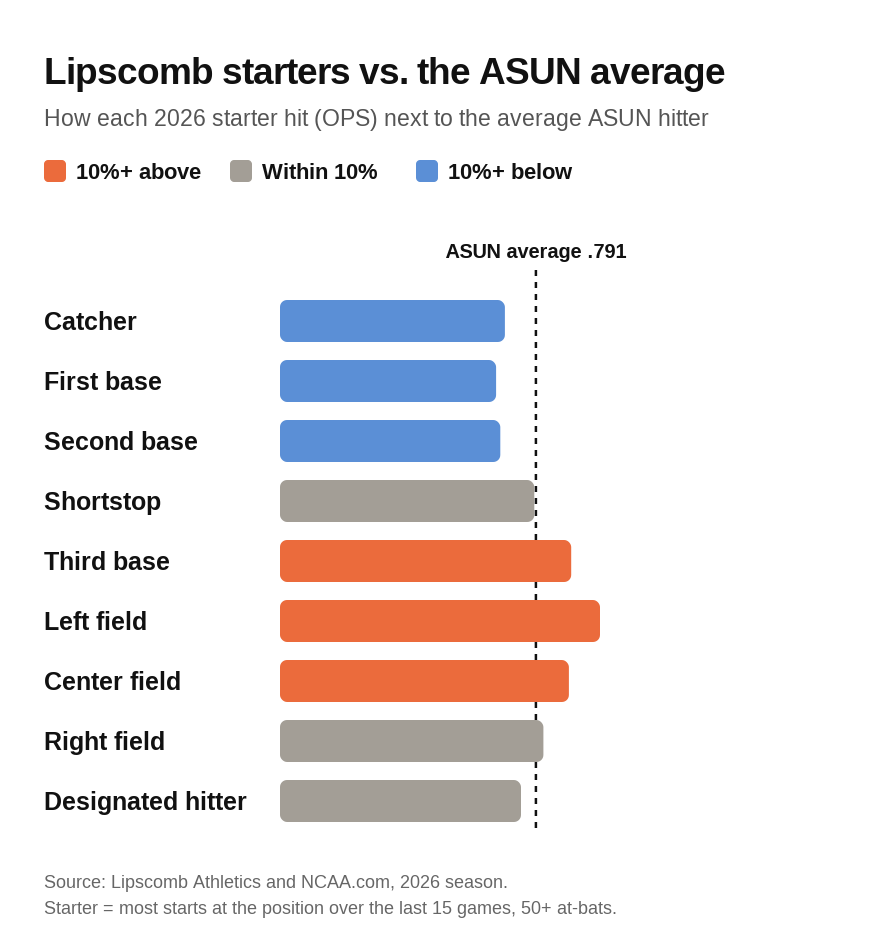
- 10% or more above the ASUN average: third base (.900), left field (.989) and center field (.893).
- Within 10% of the average: shortstop (.786), right field (.814) and designated hitter (.745).
- 10% or more below the average: catcher (.695), first base (.668) and second base (.681). These are the spots where a new player could earn at-bats.
The starter is the player with the most starts at each position over Lipscomb's last 15 games, with at least 50 at-bats. Stats come from Lipscomb Athletics and NCAA.com for the 2026 season.
What this means if you want to play at Lipscomb
- Biggest route: the junior college route brought in 19 of 51 newcomers, the most of any route.
- Tennessee high school players: 11 of 16 high school signees grew up in Tennessee, so in-state players make up most of the high school classes.
- JUCO players: Lipscomb took 19 junior college newcomers in three classes.
- Players at another four-year school: Lipscomb added 16 four-year transfers in three classes, 4 of them from Division I programs.
Whatever your route, coaches need to see your film, stats and grades in one place. Build your free recruiting page and send it to the coaches on your list.
How we got these numbers
We counted a player as a newcomer if he was on Lipscomb's roster for a season but not the season before, using Lipscomb's official roster pages for 2024, 2025, 2026 and 2027. The 2027 class is Lipscomb's fall 2026 roster, which can change before the spring season. A player's route is the last college listed for him by Lipscomb, or his high school when no college is listed. Home states come from each player's listed hometown.
Diamond Cut is not affiliated with Lipscomb University or the NCAA. This article uses public information from Lipscomb's official athletics website.